Building a first aid kit: How Medicare Advantage can help
Prepare for life’s surprises. Use over-the-counter (OTC) benefits from Medicare Advantage to stock up.
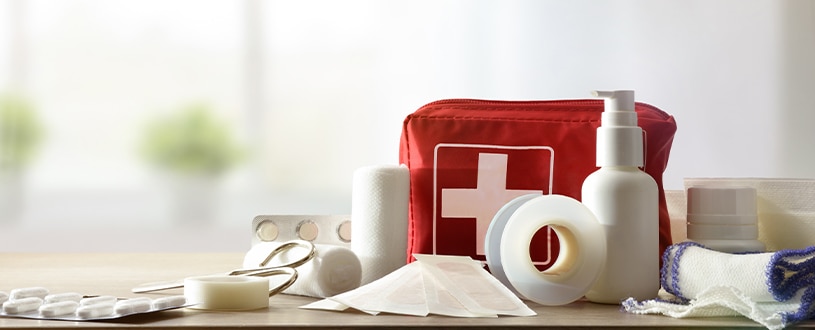
A fully equipped first aid kit is important for all households. Older adults can be vulnerable to severe weather and natural disasters and should also be careful when it comes to life’s little accidents. Common minor injuries can be quickly addressed with the right tools and know-how.
Luckily, over-the-counter (OTC) benefits, which are available from some Medicare Advantage plans to help pays for eligible OTC items, can help. Here are some tips to build a kit from scratch or keep existing resources up to date.
In this article:
What can people put into a first aid kit?
A well-stocked first aid kit for households and vehicles might include the following:
- Bandages and absorbent compresses (adhesive bandages, gauze pads, nonstick sterile pads, rolled gauze, adhesive cloth tape)
- A breathing barrier
- Antibiotic ointment packets
- Antiseptic wipe packets
- Hydrocortisone ointment packets
- Packets of baby aspirin (81 milligram)
- Personalized medications for someone’s family
- Instant cold compresses
- Protective gear (nonlatex gloves, face masks, CPR disposable face shield)
- Thermometer (without mercury and glass)
- Tweezers
- Survival rescue blanket
- Emergency first aid instructions
The kit should be kept in a water-resistant container in a central location, such as in a kitchen drawer away from the stove, sink and any hot appliances. Think somewhere cool and dry — and out of the reach of children and pets.
It’s a good idea to include emergency phone numbers of family members, health care providers and local clinics, hospitals and urgent care facilities. People can also keep a small supply of medications they take regularly. They might also consider keeping a second first aid kit in their car in case of any road-related injuries. (Having a spare never hurts.)
What items expire in a first aid kit?
People should review their first aid kit every year or as medical needs change, and check the expiration dates for all items.
In general, if a sterile item such as a bandage is still in its packaging and is still in date, it remains sterile. But if it has expired or been opened, it’s likely no longer sterile and should be thrown away immediately due to the risk of contamination.
Items with rubber or adhesive plastic in them, such as roller bandages and adhesive bandages, also deteriorate over time. If the bandages have expired, they should be thrown away.
All medications, including creams and ointments, have an expiration date. If someone can’t find the original packaging the product came in, they can assume that the product is expired and replace it.
Recommended first aid items to have on hand
Like so much of the body, skin changes as people age: The outer layer of the skin can become thinner, and blood vessels may become more fragile.
This can cause older adults to bruise more easily and take longer for those bruises to heal. About 1 in 4 adults ages 65 and older report falling every year, and these falls may lead to injuries. Seniors are also more susceptible to serious complications from catching COVID-19, respiratory syncytial virus (RSV) or the flu.
It’s a good idea to have gentle bandages and bandage wrappings in a first aid kit. These might include self-adhering wraps (which won’t stick to the skin), transparent film dressings and nonstick gauze pads. Include instant ice packs to alleviate the pain. People might also consider adding medical-grade face masks.
Remember, having a first aid kit on hand doesn’t mean people shouldn’t contact a health care provider when they get hurt. But it can help them care for themselves until they can see their health care provider.
Which first aid items are included with the OTC benefit?
The good news is that most of the items listed above are covered by the Medicare Advantage OTC benefit. Each program usually covers different types of bandages, face masks, butterfly closures, rubbing alcohol wipes, cold compression wraps and oral thermometers.
For a complete list of items that are covered by these plans, members can refer to the catalog received with their welcome pack. They can also make sure they know how to use their OTC benefit at CVS stores.

-
*FOR OVER-THE-COUNTER BENEFITS AT NO ADDITIONAL COST: Over-the-counter (OTC) allowance benefits are included in select Medicare Advantage and Medicaid plans. The allowance may only be applied to select OTC products. Allowance amount may vary by plan. Customer may be responsible for the cost of any items not covered by their plan or the cost that exceeds their allowance amount. Check with your health plan provider for more details. This content is for informational purposes only and is not medical advice. Consult your health care provider before taking any vitamins or supplements and prior to beginning or changing any health care practices.

This content is for informational purposes only and is not intended to replace professional medical advice, diagnosis or treatment. Consult your health care provider if you have any questions about medications, vitamins or supplements you may be considering or changes to your wellness or health care routines.
-
FOR WELL-STOCKED FIRST AID KIT FOR HOUSEHOLDS AND VEHICLES SOURCE: American Red Cross. Make a first aid kit. Accessed March 19, 2026.
-
FOR PROTECTIVE GEAR SOURCE: MedlinePlus. First aid kit. National Library of Medicine. Updated January 8, 2025.
-
FOR REVIEW THEIR FIRST AID KIT EVERY YEAR OR AS MEDICAL NEEDS CHANGE SOURCE: U.S. Food and Drug Administration. Don’t be tempted to use expired medicines. Updated October 31, 2024.
-
FOR IF A STERILE ITEM SUCH AS A BANDAGE IS STILL IN ITS PACKAGING AND IS STILL IN DATE SOURCE: Centers for Disease Control and Prevention. Sterilizing practices. Published November 28, 2023.
-
FOR ITEMS WITH RUBBER OR ADHESIVE PLASTIC IN THEM SOURCE: American Red Cross. Is your first aid kit expired? Published June 17, 2024.
-
FOR THE OUTER LAYER OF THE SKIN CAN BECOME THINNER SOURCE: National Institute on Aging. Skin care and aging. Updated February 11, 2025.
-
FOR CAUSE OLDER ADULTS TO BRUISE MORE EASILY SOURCE: Gould L, Abadir P, Brem H, et al. Chronic wound repair and healing in older adults: current status and future research. Journal of American Geriatrics Society. 2015;63(3):427-438.
-
FOR ABOUT 1 IN 4 ADULTS AGES 65 AND OLDER REPORT FALLING EVERY YEAR SOURCE: Centers for Disease Control and Prevention. Older adult falls data. Published February 26, 2026.
-
FOR INSTANT ICE PACKS, MEDICAL-GRADE FACE MASKS SOURCE: MedlinePlus. First aid kit. National Library of Medicine. Updated January 8, 2025.
-
FOR COVERED BY THE MEDICARE ADVANTAGE OTC BENEFIT SOURCE: Consumer Healthcare Products Associations. Using the Medicare Advantage over-the-counter (OTC) medicines program as a consumer engagement tool. Published 2021.