What causes hair loss in women? What you need to know.

Get the lowdown on what’s behind those hairs in the drain and which hair loss management products might be worth trying.
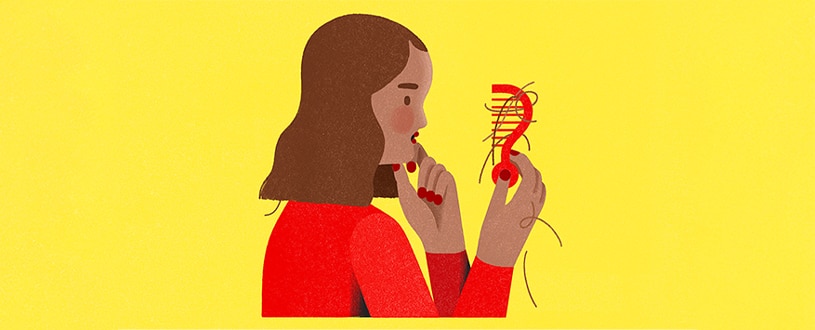
Hair grows and sheds daily. But if you’re losing more hair than usual, you may have alopecia, the medical term for hair loss.1 Experts estimate that more than half of women experience hair loss at some point in their lives for various reasons.2
“I see hair loss in my practice daily,” says Elizabeth Bahar Houshmand, MD, a dermatologist in Dallas, Texas. “Hair loss is a common concern in females of all ages.”3
Some reasons for unexpected hair loss can include genetics, hormone changes and even too-tight hairstyles like braids or a ponytail. Figuring out the cause is an important first step.
Only a medical provider can get to the root of hair concerns. But here’s some information to start your search for answers and maybe get some lost hair back.
In this article:
Hair loss in women
Some hair loss just goes hand in hand with the phases of a woman’s life. Hormone changes from childbirth or menopause can lead to a few extra strands on the brush. Age is also a driver, especially for women who have the genes for female pattern hair loss.
Hair loss can also be a side effect of stressful times or certain medications, including chemotherapy, or harsh chemicals.4 Even a tight hairstyle or frequent use of wigs, both of which can cause traction alopecia, can be a factor.5
Dr. Mary Lupo, MD, FAAD, a dermatologist in New Orleans,6 explains that hair loss is a primary complaint among some of her patients. Others only mention it at the end of a visit. Either way, she notes that it’s important to discuss with a health care provider. Even minor hair loss may mean there’s an underlying problem that could benefit from treatment.
Understanding female pattern hair loss
The most common cause of hair loss in women is female pattern hair loss, also known as androgenetic alopecia.7 In female pattern hair loss, hair follicles progressively shrink and hair becomes gradually less dense.8
“Females tend to retain their frontal hairline and will see a widening of their part,” Dr. Houshmand says. Other signs include, “having to make more loops in their ponytail or finding more hair in their hairbrush, on the floor and in the shower drain.”
The risk of female pattern hair loss increases with age, and the condition tends to run in families. Scientists have discovered genetic traits associated with female pattern hair loss. More research is needed to understand the best ways to prevent and treat it.9
“With hair loss in women, it’s important to know you are not alone,” says Dr. Houshmand. She encourages women with hair loss to, “optimize their overall health and wellness,” to improve their symptoms.
Can stress cause hair loss?
Dr. Houshmand notes that telogen effluvium, the clinical diagnosis that includes forms of stress-related hair loss, is widespread. It can happen at many stages of life and can be triggered by an illness, having a baby, starting a new job or getting surgery. Stress is one possible cause for this kind of hair loss. Other causes, such as a hormonal change, may also be responsible. She notes that the condition can appear two to three months after the stressor or change to the body.10
Fortunately, you may not need additional treatment for stress-related hair loss.11 Usually, it’s not permanent.12 Dr. Houshmand explains that in most cases, “acute telogen effluvium resolves on its own without treatment. Chronic telogen effluvium is less common and can last longer than six months.”13 A medical provider can help you determine if stress or some other reversible cause is causing the hair loss.
Other causes of hair loss in women
There are several other causes of hair loss. Some lead to telogen effluvium. Some lead to other types of hair loss.
- Autoimmune conditions: The immune system can turn against hair follicles, causing patchy hair loss. An example of this is alopecia areata. In some cases, this is reversible.14
- Cancer treatment: Chemotherapy and radiation may cause hair loss as a side effect.15
- Central centrifugal cicatricial alopecia: A small balding patch in the center of the scalp grows over time. This is more common in Black women.16
- Dieting: If you’re on a restrictive diet, vitamin deficiencies and rapid weight loss may lead to thinner hair.17
- Hormone imbalance: Hormonal conditions like polycystic ovary syndrome can cause hair loss.18 Hormonal birth control can infrequently cause hair loss though it is usually temporary.19
- Scalp psoriasis: If you have a skin condition like plaque psoriasis, it may affect your scalp and hair.20
- Sexually transmitted infections: Diseases like syphilis can lead to patchy hair loss on the head and face when left untreated.21
- Thyroid disease: Thyroid problems can cause hair loss that’s reversible with medical treatment.22
- Toxicities: Exposure to arsenic, lithium, mercury, selenium, thallium, large amounts of vitamin A and warfarin may cause hair loss.23
Many of these causes work in different ways. Some are reversible while others aren’t. So, figuring out the reason for hair loss is a critical first step.
“I always recommend having a thorough scalp evaluation and health evaluation,” says Dr. Houshmand. For instance, it may be as simple as a lack of the right vitamins. “Many common deficiencies in women include low iron levels, thyroid abnormalities and vitamin D deficiency.”24
Hair growth products and practices for women
Once you understand your hair loss a little better, a health care provider can suggest products, procedures or perhaps prescriptions to help manage the problem.
Luckily, there are a few ways to help stop hair loss. Minoxidil is a popular ingredient with proven benefits for hair regrowth in some instances. The Federal Drug Administration (FDA) has approved its use for female pattern hair loss.25
Hair regrowth serums containing minoxidil include CVS Health® women’s 2% minoxidil solution for hair regrowth and CVS Health women’s 5% minoxidil foam for hair regrowth. Other hair loss management products might be worth a look. Make sure you choose a product formulated for women because the product or directions may be different for men.
Adequate nutrition through food and sometimes supplements is also essential. “I like to recommend lifestyle changes and making sure your diet is optimized with adequate levels of protein,” says Dr. Houshmand. In addition, she says, “The health of the scalp is critical for hair growth.”
Although they can’t treat hair loss, gentle hair styling products may help prevent damage and breakage. Mane ‘n Tail detangler and Scunci no-damage thick hair elastics are two products to consider.
Discuss options with your health care provider before attempting to treat yourself at home. After proper testing and a review of your medical history, your doctor can offer individualized medical advice that’s safe and effective for you.
Hair loss frequently asked questions (FAQs)
- How much hair is normal to lose per day? Humans lose an average of 50 to 100 individual hairs each day.26
- Does shaving your head make the hair grow back thicker? Unfortunately, this is a myth. Shaving your head will not lead to thicker hair.27
- Is hair loss just a normal part of aging? Most men and women experience hair loss or thinning with aging. However, finding and treating the issue early on can help.28
This content is for informational purposes only and is not medical advice. Consult your health care provider before taking any vitamins or supplements, and prior to beginning or changing any health care practices.
-
-
2 Hair loss in women . Cleveland Clinic.
-
3 Elizabeth Houshmand, interview, October 2023
-
4 Hair loss in women. Cleveland Clinic.
-
-
6 Mary Lupo, interview, September 2023
-
7 Thinning hair and hair loss: Could it be female pattern hair loss? American Academy of Dermatology Association. December 13, 2022.; https://medlineplus.gov/genetics/condition/androgenetic-alopecia/
-
8 Müller Ramos P, Melo DF, Radwanski H, et al. Female-pattern hair loss: therapeutic update . Anais Brasileiros de Dermatologia. 2023;98(4):506-519.
-
9 Ho CY, Chen JYF, Hsu WL, et al. Female pattern hair loss: an overview with focus on the genetics . Genes. 2023;14(7):1326.
-
10 Hall-Flavin DK. Can stress cause hair loss? . Mayo Clinic. May 10, 2023. https://www.ncbi.nlm.nih.gov/pmc/articles/PMC7320655/
-
11 Hall-Flavin DK. Can stress cause hair loss? . Mayo Clinic. May 10, 2023.
-
12 Hair loss in women . Cleveland Clinic.
-
-
-
15 Hair loss: Who gets it and causes. American Academy of Dermatology Association.
-
-
17 Hair loss in women. Cleveland Clinic.
-
18 Hair loss: Who gets it and causes. American Academy of Dermatology Association.
-
-
20 Hair loss: Who gets it and causes . American Academy of Dermatology Association.
-
21 Hair loss: Who gets it and causes. American Academy of Dermatology Association.
-
22 Hair loss: Who gets it and causes. American Academy of Dermatology Association.
-
23 Hair loss: Who gets it and causes. American Academy of Dermatology Association.
-
-
-
26 Hair loss in women. Cleveland Clinic.
-
27 Hair loss in women. Cleveland Clinic.; https://www.mayoclinic.org/healthy-lifestyle/adult-health/expert-answers/hair-removal/faq-20058427
-
28 Hair loss: Who gets it and causes. American Academy of Dermatology Association.

You may also like
-
Published: March 18, 2024 | 8 minutes to read
-
Published: March 18, 2024 | 7 minutes to read
-
Updated: July 31, 2024 | 8 minutes to read